
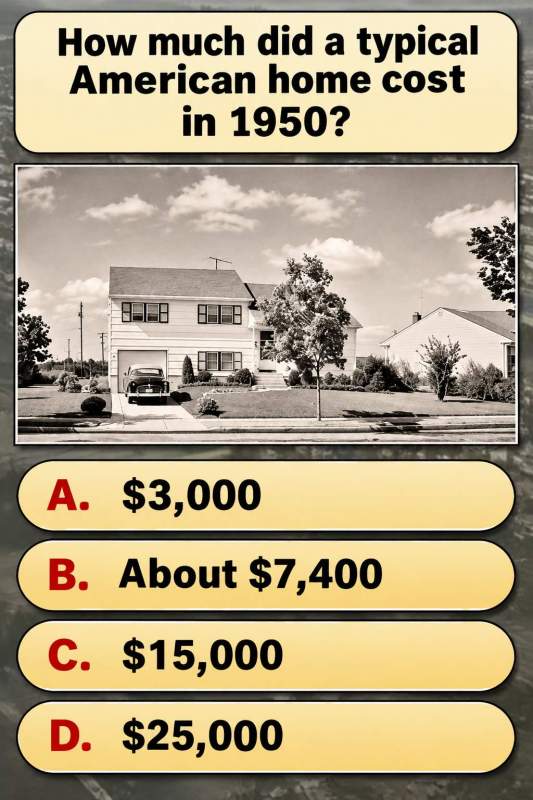
1. A Look Back at the American Dream in 1950
Imagine walking through an American neighborhood in 1950. The streets are quiet, children are playing outside, and modest family homes sit on spacious lawns. Many houses feature front porches, simple kitchens, wooden floors, and comfortable living rooms where families gather in the evening.
For millions of Americans, owning a home represented independence, financial security, and the beginning of a better future.
But what did it actually cost to purchase a typical American home during this period?
Today, buying a house can require decades of mortgage payments and a substantial financial commitment. Looking back at the housing market of 1950 reveals a dramatically different world.
Was an average home worth just $3,000? Was it approximately $7,400, $15,000, or even $25,000?
The answer provides a fascinating glimpse into postwar America, when suburban communities were expanding and homeownership was becoming an important part of the American dream.

2. Four Possibilities: What Did an American Home Cost in 1950?
Let’s examine the four possible answers and understand what each price might have represented during that era.
A. $3,000
One possibility is that a typical American home cost approximately $3,000.
This amount might sound reasonable when looking at old photographs of modest houses from the early 1950s.
Many homes built during this period were relatively simple compared with modern properties. They often featured smaller floor plans, basic kitchens, modest bathrooms, and straightforward architectural designs.
However, even though housing was considerably more affordable than it is today, $3,000 would have been unusually low as a general estimate of the value of an American home in 1950.
B. About $7,400
Another possibility is approximately $7,400.
This figure is particularly interesting because historical American housing statistics place the typical value of owner-occupied homes during 1950 in roughly this range.
For families entering the housing market, this represented a significant financial investment.
The amount also reflected the relatively modest size and simpler construction of many postwar American houses.
A home at this price could provide a family with bedrooms, a kitchen, a living room, and a small yard.

C. $15,000
A third possibility is $15,000.
This amount might seem plausible because some larger or more expensive houses were already available during the 1950s.
Properties in desirable neighborhoods, larger homes, and houses featuring additional amenities could cost substantially more than modest starter homes.
However, the question concerns a typical American home rather than a luxury property or a particularly expensive real-estate market.
D. $25,000
The final possibility is $25,000.
For many American families in 1950, this would have represented a substantial housing purchase.
A home at this price might have featured more living space, a desirable location, or higher-quality finishes.
Although such properties certainly existed, this figure would not accurately represent the typical value of an American home during the period.
3. The Reveal: How Much Was a Typical American Home Worth in 1950?
Correct Answer: B
The correct answer is B) About $7,400.
According to historical U.S. Census Bureau statistics, the median value of an owner-occupied American home in 1950 was exactly $7,354.
That is remarkably close to the answer in the quiz. www2.census.gov+1
This means that half of the owner-occupied homes included in the survey were valued below that figure and half were valued above it.
It is important to understand that this was the median value of existing owner-occupied homes, not necessarily the purchase price of every newly constructed house.
Still, the figure gives us an excellent picture of the American housing market during the early postwar years.
For families living in 1950, owning a house worth approximately $7,400 represented a significant financial milestone.
4. The Story Behind America’s Postwar Housing Boom
The 1950s were an extraordinary period for American housing.
Following World War II, millions of American families were looking for homes. Returning veterans were starting families, getting married, and searching for places to settle down.
The demand for affordable housing increased dramatically.
Builders responded by constructing entire suburban neighborhoods filled with modest single-family houses.
One of the most famous examples was Levittown in New York, which became a symbol of the postwar suburban housing boom.
Its homes featured relatively simple designs, practical layouts, and standardized construction methods.

These developments helped make homeownership possible for many families who previously struggled to afford a house.
Government-backed mortgage programs also played an important role in expanding access to home financing, particularly for eligible returning veterans.
The GI Bill helped eligible veterans obtain more favorable mortgage financing through the VA home loan program.
However, access to these opportunities was not equal. Discriminatory housing policies and lending practices excluded many Black Americans and other minority families from the benefits of postwar suburban expansion.
The typical American house during this period was often smaller and simpler than many modern homes.
A modest property might include:
- Two or three bedrooms.
- One bathroom.
- A small kitchen.
- A living room for family gatherings.
- A modest backyard.
- A driveway or small garage.
Many homes were designed around practical family living rather than luxury.
Interestingly, the 1950 Census also recorded that approximately 55 percent of occupied housing units were owner-occupied. 785+1
Homeownership was becoming an increasingly important part of American life.
The suburban lifestyle, with its lawns, family cars, neighborhood schools, and local shopping centers, became a defining image of the decade.
5. Did You Know? 5 Surprising Facts About American Homes in 1950
– The median home value was $7,354. This is the official historical figure reported in U.S. Census housing statistics. www2.census.gov
– Homeownership was already widespread. Approximately 55 percent of occupied American homes were owner-occupied in 1950. 785
– Average family income was around $3,300 annually. This gives some perspective on the financial commitment involved in buying a house. www2.census.gov
– Electricity was becoming nearly universal. Approximately 94 percent of American homes had electricity in 1950. www2.census.gov
– Suburban development transformed American life. Large planned communities helped accommodate the growing demand for family housing after World War II.
6. A Little Nostalgia: Who Remembers These 1950s Neighborhoods?
For people who grew up during the 1950s and 1960s, these houses may bring back wonderful memories.
Perhaps you remember living in a modest family home with a small front porch, a wooden fence, and a garden where children played after school.
Maybe your parents bought their first house during this period, carefully saving money and making monthly mortgage payments.
You might remember the neighborhood children riding bicycles along quiet streets, families gathering for backyard barbecues, and neighbors knowing one another by name.
Life was not necessarily easier for everyone, but many people remember the sense of community that came with these traditional neighborhoods.
For younger generations, a house worth $7,400 may sound almost unbelievable.
But for families in 1950, that amount represented years of work, careful saving, and the hope of building a secure future.
7. One Last Question for Those Who Remember the Good Old Days

In 1950, the median value of an owner-occupied American home was approximately $7,354, making $7,400 the closest answer in this classic history quiz.
It was a time when modest suburban houses, expanding neighborhoods, and the dream of homeownership helped shape American society.
Did your parents or grandparents own a house during the 1950s? Do you remember what they paid for it, and what the neighborhood looked like back then?
Share your memories in the comments! We’d love to hear your stories about family homes, childhood neighborhoods, and the good old days.